Foundational Stage
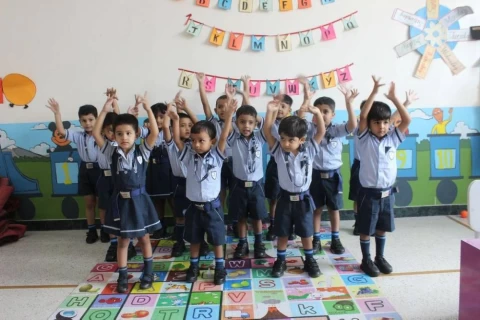
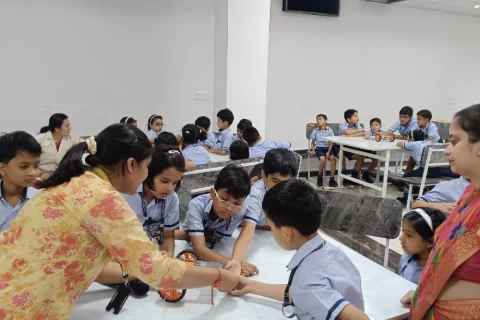
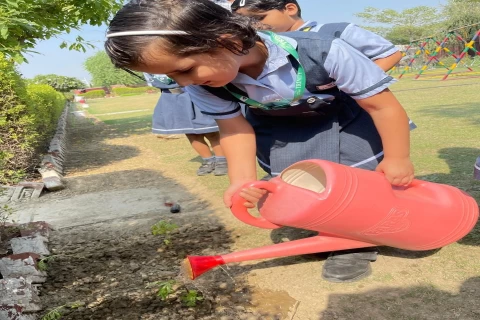
The Foundation Stage is for children of the age 3 to 8.
Children start schooling in the
Foundational Stage. The design is based on the principles of Early Childhood Care and
Education (ECCE).
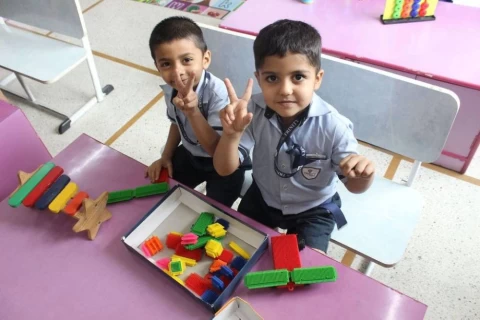
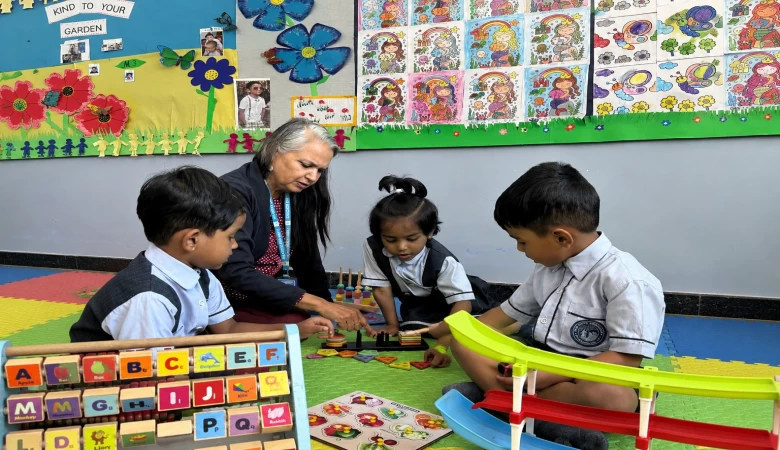
ECCE ideally consists of flexible, multi-faceted, multi-level, play-based, activity-based, and
inquiry-based learning, comprising of alphabets, languages, numbers, counting, colours,
shapes, indoor and outdoor play, puzzles and logical thinking, problem-solving, drawing,
painting and other visual art, craft, drama and puppetry, music and movement. It also
includes a focus on developing social capacities, sensitivity, good behaviour, courtesy,
ethics, personal and public cleanliness, teamwork, and cooperation. The overall aim of
ECCE will be to attain optimal outcomes in the domains of: physical and motor development,
cognitive development, socio-emotional-ethical development, cultural/artistic development,
and the development of communication and early language, litera- cy, and numeracy.” [NEP
2020, 1.2]
The Foundational Stage bridges the divide between the home environment of the child and
the formal school environment. It develops capacities in Foundational Literacy and
Numeracy that enables the student to learn all other subject areas. In addition to these
capacities, it develops valuable dispositions for active learning and would enable the
students to become engaged learners in formal school environments. Play and exploration
are the natural modes through which children learn and the Foundational Stage utilizes
these modes to promote the valuable capacities and dispositions.
Preparatory Stage
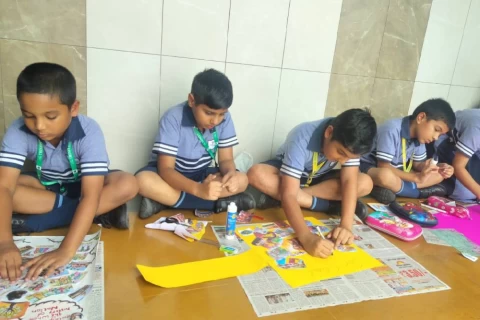
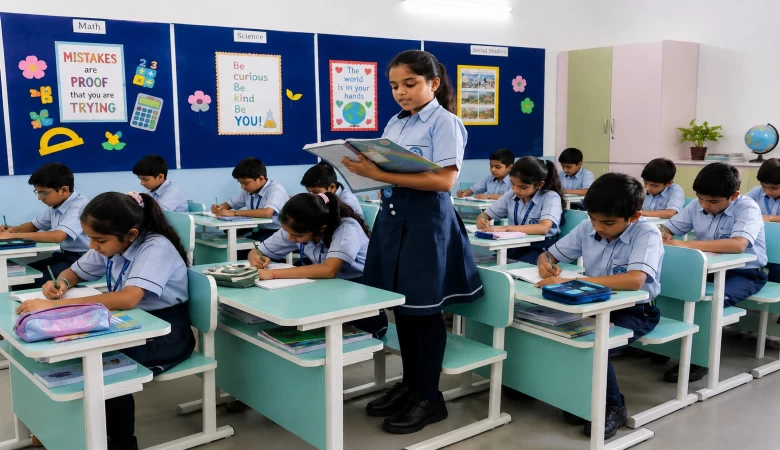
The Preparatory Stage is for three years and includes Grades 3,4, and 5.
“The Preparatory Stage will comprise three years of education, building on the play-,
discovery-, and activity-based pedagogical and curricular style of the Foundational Stage,
but also gradually beginning to incorporate textbooks as well as aspects of more formal
classroom learning. There would mostly be generalist teachers during this stage, with the
possible exception of some specialist language and art teachers (who may be shared across
the school or school complex). The aim of this stage will be to lay the general groundwork
across subjects, including reading, writing, speaking, physical education, art, languages,
science, and mathematics, so that students are prepared to delve deeper into learning areas
through specialised subjects and subject teachers in the stages that follow.”
The Preparatory Stage curriculum of the NCF is divided into the following curricular areas –
languages, mathematics, arts, physical education, and the world around us. The world
around us is an interdisciplinary area that encourages exploration and understanding of both
the natural world and the social world. Aspects of work in vocational education are also
incorporated into this curricular area.
The Preparatory Stage consolidates the capacities and dispositions that begin to develop in
the Foundational Stage. Students are expected to develop fluency in literacy and numeracy
and de- velop further capacities that are helpful in a systematic exploration of the natural and
social worlds around them.
Middle Stage
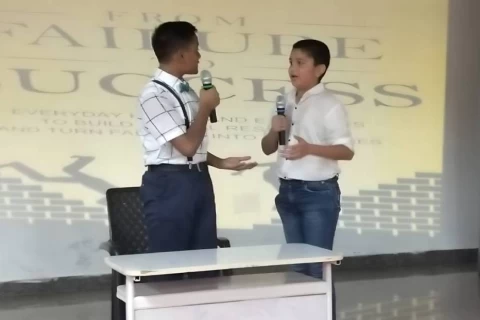
The Middle Stage is for three years and includes Grades 6, 7, and 8.
“The Middle Stage will comprise three years of education, building on the pedagogical and
curricular style of the Preparatory Stage, but with the introduction of subject teachers for
learning and discussion of the more abstract concepts in each subject that students will be
ready for at this stage across the sciences, mathematics, arts, social sciences, and
humanities. Experiential learning within each subject, and explorations of relations among
different subjects, will be encouraged and em- phasized despite the introduction of more
specialized subjects and subject teachers.”
The Middle Stage utilizes the capacities and dispositions developed during the Preparatory
Stage and introduces the students to different forms of understanding. Students gain
systematic knowledge through rational thought and enquiry. The capacities for critical
thinking and prob- lem-solving are consolidated in this stage and they acquire the desirable
values and dispositions for democratic/economic/cultural participation.
The Middle Stage expands the curricular areas to include the Sciences – the study of the
natural world, and Social Sciences – the study of the human world, and students get
exposure to Vocational Education. Based on the capacities and dispositions in the
Preparatory Stage, students engage more formally with knowledge and values in the Middle
Stage. Curricular Areas are dealt with as ‘forms of understanding’ with explicit engagement
with paradigmatic theories and conceptual structures that frame each area. The more
generic capacities (like observation and data collection) developed in the Preparatory Stage
are now specialized into specific methods of inquiry that is appropriate for each form of
understanding. For e.g., students gain an understanding of the scientific method of inquiry
and also contrast it with methods of inquiry in history or in the arts. The conventions and
protocols of each form of understanding are also introduced in the middle stage.
Senior Secondary Stage
The Secondary Stage is for four years and includes Grades 9, 10, 11 and 12.
“The Secondary Stage will comprise of four years of multidisciplinary study, building on the
sub- ject-oriented pedagogical and curricular style of the Middle Stage, but with greater
depth, greater critical thinking, greater attention to life aspirations, and greater flexibility and
student choice of subjects. In particular students would continue to have the option of exiting
after Grade 10 and re-entering in the next phase to pursue vocational or any other courses
available in Grades 11-12, including at a more specialized school, if so desired.”
The Secondary Stage will be divided into two phases:
1. Broad Curricular Areas (e.g., Science, Social Science, Humanities) will be offered in
Grade 9 and 10 to enable breadth. Learning Standards are defined for this phase, and it
is expected that all students attain these learning standards.
2. Disciplines (e.g., History, Physics, Language) within each Curricular Area will be offered
in Grade 11 and 12 to enable depth. The students have a choice in selecting specific
areas and disciplines. They make these choices based on their interests and their future
plans either in the world of work or in higher education after their school completion.
There are no common learning standards for this phase, while each of the disciplines
would have its specific competencies and learning outcomes defined.